
Sciatica Chiropractor in Phoenix–Ahwatukee
Sciatica is the name for pain, tingling or numbness that travels along the sciatic nerve, from the lower back through the buttock and down the back of the leg. It can make sitting through a drive on the I-10, a workday at a desk, or a hike up South Mountain hard to manage. Life Chiropractic sees people with sciatica-type leg pain at our Ahwatukee office on Ray Road and at our North Scottsdale office. This page explains what sciatica is, the warning signs that mean you should see a medical doctor first, what a first visit with us looks like, and how we decide whether chiropractic care is a reasonable fit for you.
What sciatica is, and what it isn’t
Sciatica isn’t a diagnosis on its own. It describes symptoms that come from pressure on or damage to the sciatic nerve. The U.S. National Library of Medicine’s MedlinePlus encyclopedia explains that this nerve starts in the lower back and runs down the back of each leg, supplying muscles behind the knee and lower leg and sensation to the back of the thigh, the outer and back part of the lower leg, and the sole of the foot. That’s why sciatica can show up as anything from a dull ache in the buttock to a burning or electric pain below the knee.
MedlinePlus lists these common causes:
- A slipped or herniated disk
- Spinal stenosis (narrowing around the nerves)
- Piriformis syndrome, involving a narrow muscle in the buttock
- Pelvic injury or fracture
- Spondylolisthesis, where one vertebra slips forward on another
- Less often, tumors
Not every pain in the back of the leg is sciatica. Hip joint problems, tight hamstrings, and pain referred from the sacroiliac joint can feel similar. Sorting these out is the first job of an exam, and it’s why we don’t start adjusting before we’ve looked closely at what’s going on.
See a medical doctor first if you have these warning signs
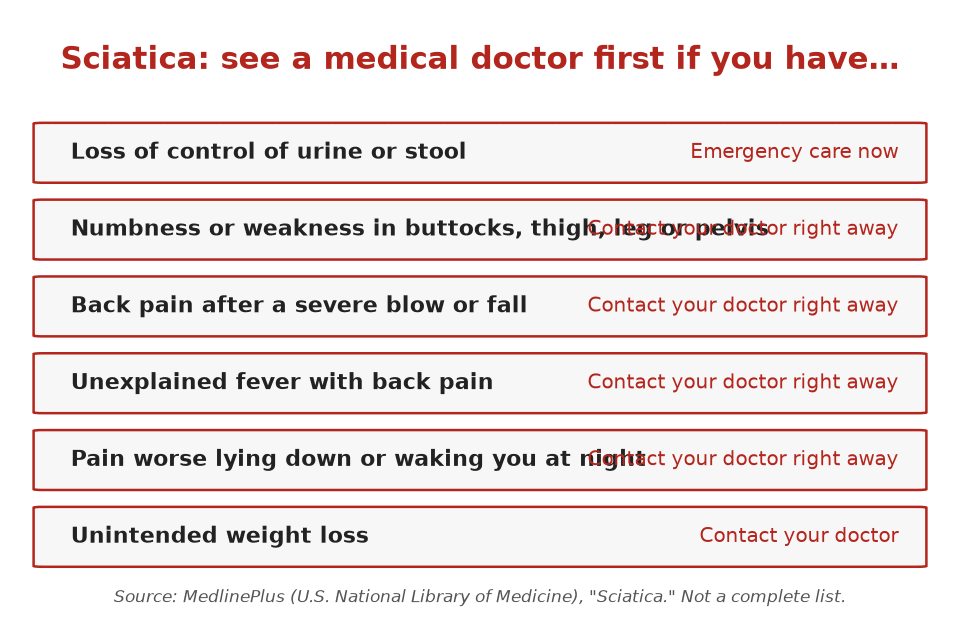
Some back and leg pain needs medical care before anything else. MedlinePlus advises contacting a provider right away if you have:
| Symptom | What to do |
|---|---|
| Loss of control of urine or stool | Go to the emergency room |
| Weakness or numbness in your buttocks, thigh, leg or pelvis | Contact a medical provider right away |
| Back pain after a severe blow or fall | Contact a medical provider right away |
| Unexplained fever with back pain, or redness or swelling on the spine | Contact a medical provider right away |
| Pain that’s worse lying down or wakes you at night | Contact a medical provider right away |
| Unintended weight loss, steroid use, or injected drug use | Contact a medical provider |
If any of these apply, please don’t book a chiropractic visit first. Call your doctor, or 911 for an emergency. If you come to us and we find one of these signs, we’ll stop and refer you out.
Sciatica, a herniated disc, or piriformis? Why the source matters
Two people with the same leg pain can need very different care. A disc that’s pressing on a nerve root behaves differently from a tight piriformis muscle or a narrowed spinal canal. The table below shows the kinds of questions we use to tell them apart. It’s a guide to how we think, not a self-diagnosis tool.
| Possible source | Things we ask about and check | What usually happens next |
|---|---|---|
| Disc-related nerve irritation | Pain with sitting or bending forward, leg pain below the knee, nerve and reflex tests | Chiropractic plan may include decompression; MRI referral if nerve signs are significant |
| Spinal stenosis | Leg symptoms with standing or walking that ease when you sit or lean forward | Gentle care if appropriate; medical referral for imaging and options |
| Piriformis or buttock muscle | Buttock tenderness, pain with sitting on hard surfaces, hip rotation tests | Soft-tissue work such as Graston or massage plus home stretches |
| Sacroiliac or pelvic joint | Pain near the dimples of the low back, pain with stairs or rolling in bed | Adjustments and pelvic blocking may be considered |
| Something outside the spine | Fever, weight loss, night pain, symptoms that don’t fit a mechanical pattern | Referral to a medical doctor |
For disc problems specifically, see our herniated disc page.
What your first visit looks like
- Free consultation. You tell us where the pain goes, what makes it better or worse, and what you want to get back to doing. There’s no charge for this conversation.
- History and red-flag screening. We ask about the warning signs above, your health history and any medications.
- Exam. We check posture, how your low back and hips move, and nerve function in the legs, such as strength, sensation and reflexes.
- X-rays when they’re appropriate. We can take X-rays in our office. X-rays show bone and alignment but don’t show discs or nerves directly, so if we think you need an MRI, we refer you to a provider who can order it.
- Findings and options. We explain what we found in plain language, whether we think chiropractic care is a reasonable fit, and what else you might consider.
- Re-checks. If you start care, we re-check your progress. If things aren’t moving in the right direction, we change the plan or refer you out.
How we treat sciatica at Life Chiropractic
For more than 30 years, Life Chiropractic has practiced corrective chiropractic care in Ahwatukee, and today we see patients at our North Scottsdale office too. Our approach starts with listening with compassion and understanding. We ask about your life history, any previous injuries and your medical background before anything else. Many of our patients come to us with long-standing problems, so we look for the underlying cause rather than just the symptoms, and we tell you honestly whether chiropractic care is a good fit.
For sciatica, that means a thorough physical exam of your low back, pelvis and legs, with digital X-rays when they’re appropriate. Depending on what we find, your plan may combine gentle adjustments with pelvic blocking, spinal decompression, Graston soft-tissue work or massage. Not everyone needs every tool, and your exam decides which ones we use.
We invite your loved ones to join the findings and recommendations meeting after your initial consultation, so they can see what you’ve been going through and ask their own questions. Then we explain what we found in plain language before any care begins. If you start care, we re-check your progress with exams and, when appropriate, X-rays, and we refer you out for an MRI or a surgical opinion when that’s the right next step. Every adjustment is gentle and adapted to your age, size and comfort. As we like to say, healthy living begins with Life.
Tools we may use for sciatica
Every plan is built from the exam, so not everyone gets every tool. The options available at Life Chiropractic include:
- Chiropractic adjustments to the low back and pelvis, adapted to your comfort level.
- Pelvic blocking, which uses padded wedges under the pelvis while you lie down to apply a gentle, low-force correction.
- Spinal decompression, a table-based approach we may consider for disc-related cases.
- Graston technique, instrument-assisted soft-tissue work for tight or irritated muscles such as the glutes and hamstrings.
- Massage to help with muscle guarding around the low back and hips.
- Home care: positions to try, how to sit at work, and movements to ease back into.
Our back pain page covers low back pain without leg symptoms, and our corrective care page explains our longer-term approach.
What the research says, honestly
We’d rather you know the evidence than hear a sales pitch. The NIH’s National Center for Complementary and Integrative Health summarizes the research on spinal manipulation and says spinal manipulation may lead to small improvements in low-back pain and function. It also notes that temporary soreness, stiffness or headache are common after manipulation and usually fade within 24 hours, and that serious side effects have been reported but are very rare. Everyone responds differently, and we can’t promise a particular result or timeline.
Everyday tips while you’re dealing with sciatica
- Break up long sitting. Long commutes and desk days are a common complaint. Standing up and walking for a minute or two often feels better than sitting through it. Our article on stand-up desks has ideas.
- Stay gently active within comfort. Early-morning or evening walks avoid the worst of the Phoenix heat.
- Watch your sleep position. A pillow between the knees when lying on your side helps some people.
- Know how long it typically lasts. Read our article How long does sciatica last?, and if your symptoms are spreading to your knee, see Can sciatica cause knee pain?.
Sciatica care for Ahwatukee, Phoenix and nearby
Our Phoenix–Ahwatukee office is at 4722 E. Ray Rd., Ste 5, close to the I-10 and convenient for people in Ahwatukee Foothills, Chandler, Tempe and south Phoenix. Our North Scottsdale office serves Scottsdale and north Phoenix. Visit our Ahwatukee office page or our North Scottsdale office page for hours and directions.
Frequently asked questions
Can a chiropractor help with sciatica?
Chiropractic care is one non-surgical option many people with sciatica try. The NIH’s National Center for Complementary and Integrative Health says spinal manipulation is one of several non-drug approaches used for low-back pain and may lead to small improvements in pain and function. Research specific to sciatica is more limited. At Life Chiropractic we start with an exam to see whether your symptoms fit a pattern chiropractic care may help, and we refer you out when they don’t.
Do I need an MRI before seeing a chiropractor for sciatica?
Not usually. Many people come in without imaging. If your exam suggests a problem that needs an MRI, such as signs of significant nerve compression, we refer you to a medical provider who can order one. We can take X-rays in our office when they’re appropriate.
When is sciatica an emergency?
According to MedlinePlus, you should contact a medical provider right away if you lose control of your bladder or bowels, have new numbness or weakness in the buttocks, thigh, leg or pelvis, have back pain after a severe fall or blow, or have unexplained fever with back pain. Loss of bladder or bowel control needs emergency care, not a chiropractic visit.
What causes sciatica?
Sciatica happens when the sciatic nerve is pressed on or damaged. MedlinePlus lists common causes including a herniated disk, spinal stenosis, piriformis syndrome, pelvic injury and spondylolisthesis. Because the causes differ, the right care plan depends on what your exam shows.
Do you offer spinal decompression for sciatica?
Yes. Spinal decompression is one of the tools we offer in addition to adjustments, Graston soft-tissue work, pelvic blocking and massage. Whether it fits your case depends on your exam. You can read more on our herniated disc page.
Will I need surgery?
We can’t answer that, and we don’t promise that care will help you avoid surgery. If your symptoms or exam point toward a surgical question, we refer you to a surgeon for an opinion.
Is sciatica in pregnancy treated differently?
Yes, care is adapted for pregnancy. See our prenatal chiropractic page and our article on managing back pain in pregnancy.
Book a free sciatica consultation
If leg pain is getting in the way of sitting, sleeping or staying active, and you don’t have any of the warning signs above, we’re glad to take a look. Consultations are free. Call the Phoenix–Ahwatukee office at 480-460-1399 (4722 E. Ray Rd., Ste 5, Phoenix, AZ 85044), call North Scottsdale at 480-563-5000, or request an appointment online.
This page is general information, not medical advice or a diagnosis. Chiropractic care is not right for everyone, and results vary from person to person. If you have any of the warning signs above, see a medical doctor or go to the emergency room.